Agentic Commerce: When AI Agents Do the Shopping for Your Customers
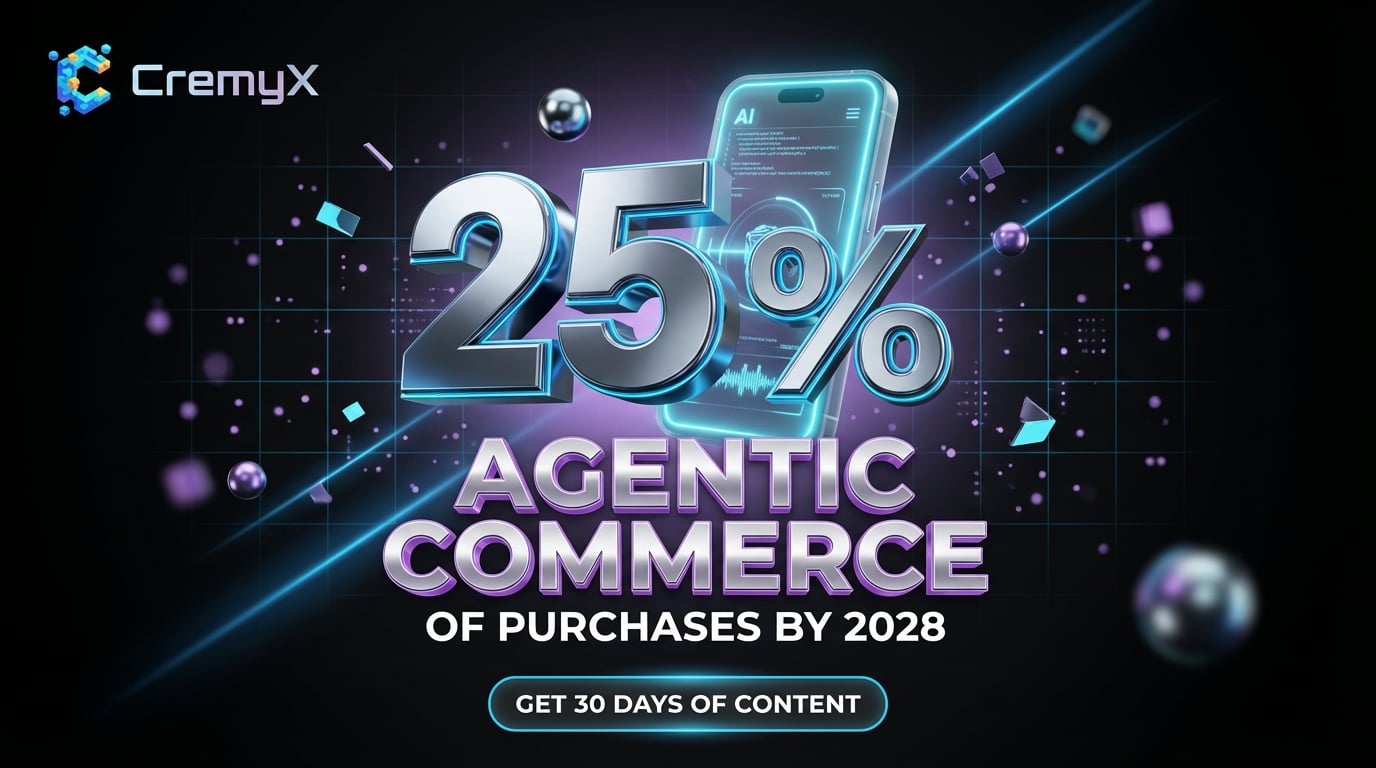
What is Agentic Commerce?
Agentic Commerce describes a new e-commerce paradigm where autonomous AI agents act as purchasing intermediaries between consumers and brands. Instead of a human browsing Amazon, comparing reviews, and clicking "Buy Now," an AI agent performs the entire shopping journey:

- Intent Understanding: The agent interprets what the user actually needs, not just what they search for
- Research & Comparison: It scans multiple vendors, reads reviews, and compares specifications
- Negotiation: Some agents can negotiate prices or find the best available deals
- Purchase Execution: The agent completes the transaction with stored payment information
- Post-Purchase Management: Tracking deliveries, handling returns, managing warranties
Why Agentic Commerce Changes Everything
Traditional e-commerce optimization focuses on human psychology — eye-catching images, persuasive copy, urgency timers. But AI agents don't respond to these tactics. They evaluate products based on:
| Human Buyer | AI Shopping Agent |
|---|---|
| Attracted by visuals and branding | Evaluates structured data and specs |
| Influenced by social proof (reviews) | Analyzes review sentiment at scale |
| Susceptible to urgency/scarcity | Ignores artificial pressure tactics |
| Compares 3-5 options manually | Compares hundreds of options instantly |
| Brand loyalty plays a large role | Optimizes purely for user's stated preferences |
How to Optimize Your Brand for AI Shopping Agents
1. Structured Product Data is Non-Negotiable
AI agents parse structured data far more efficiently than natural language product descriptions. Implement comprehensive Schema.org markup for every product:
- Product schema with full specifications
- Offer schema with pricing and availability
- Review/Rating schema with aggregate scores
- FAQ schema addressing common purchase questions
2. Machine-Readable Product Descriptions
While your human-facing copy can be creative, ensure that agents can extract key facts easily. Structure descriptions with clear attribute-value pairs: material, dimensions, compatibility, warranty terms, and use cases.
3. API-First Commerce Strategy
Forward-thinking brands are building APIs that AI agents can directly query for real-time inventory, pricing, and product information. This gives your products a speed advantage — agents can get your data faster than scraping competitor websites.
4. Review and Reputation Management
AI agents aggregate and analyze reviews across platforms. A consistent 4.2-star rating across 10,000 reviews carries more weight than a 4.8-star rating across 50 reviews. Focus on volume and authenticity over perfection.
5. Competitive Pricing Intelligence
Agents will compare your pricing in real-time against every competitor. Dynamic pricing strategies become essential — not to race to the bottom, but to ensure your value proposition is clear when an agent evaluates price-to-value ratios.
The Role of Content in Agentic Commerce
Content marketing doesn't disappear in an agentic world — it transforms. Instead of creating content to attract human browsers, you create content that AI agents reference when making purchasing decisions:
- Comparison guides that agents can parse for feature matrices
- Technical documentation that answers agent queries definitively
- Use case studies that help agents match products to user needs
Platforms like CremyX are evolving their content generation capabilities to produce both human-engaging and agent-readable content simultaneously. CremyX's Brand DNA analysis ensures that product messaging remains consistent across all formats, while its Content Themes system can be configured to output structured, machine-parseable content alongside creative copy.
CremyX is actively researching product feed optimization capabilities that would allow brands to automatically generate agent-optimized product descriptions at scale — ensuring every product in your catalog is discoverable by AI shopping agents.
Industries Most Affected by Agentic Commerce
- Consumer Electronics: High-spec comparison shopping is ideal for agents
- Travel & Hospitality: Complex multi-factor decisions agents excel at
- Financial Products: Rate comparison and qualification matching
- B2B Procurement: Bulk purchasing and vendor evaluation
- Subscription Services: Feature-by-feature comparison across plans
Preparing Your E-commerce Stack
Immediate Actions (Today)
- Audit your Schema.org implementation for completeness
- Ensure product data is accessible without JavaScript rendering
- Build a comprehensive FAQ section for each product category
Medium-Term (6-12 Months)
- Develop product APIs for direct agent access
- Implement dynamic pricing with agent-aware strategies
- Create machine-readable comparison content
Long-Term (12-24 Months)
- Build agent-specific shopping experiences
- Develop partnerships with major AI assistant platforms
- Create feedback loops from agent interactions to product development
The Metrics That Matter in Agentic Commerce
- Agent Discovery Rate: How often AI agents surface your products
- Agent Conversion Rate: How often agent recommendations lead to purchase
- Structured Data Coverage: Percentage of products with complete schema markup
- API Response Time: Speed of your product data API for agent queries
For more on optimizing for AI-driven discovery, read our guides on GEO: Generative Engine Optimization and Answer Engine Optimization (AEO).
💡 Put These Tips Into Action with CremyX
Stop reading tips and start implementing them. CremyX analyzes your brand and generates ready-to-publish content that follows these best practices automatically.
Learn more: AI Marketing for Small Business · Best AI Tools FAQ