AI-Powered Paid Media: How Input Quality Determines Ad Performance in 2026
TL;DR
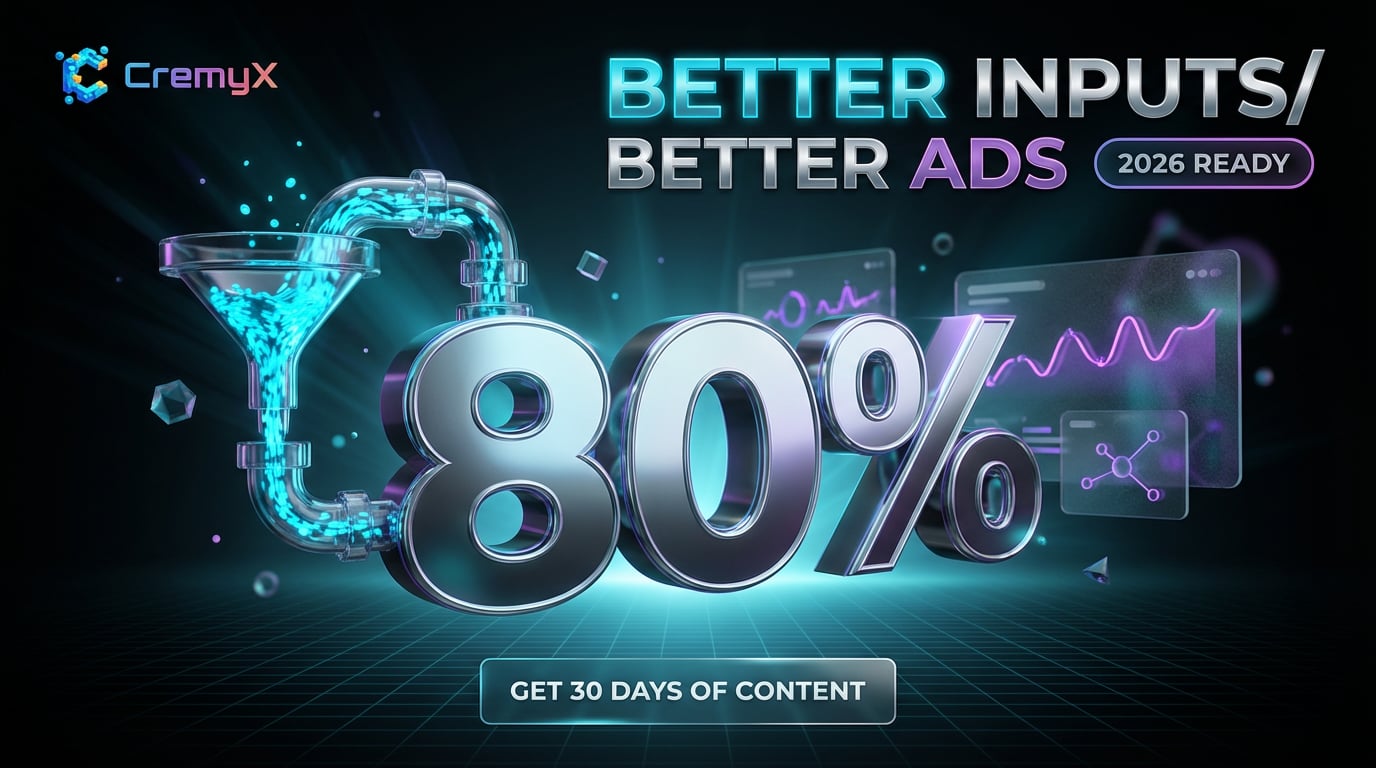
Google Performance Max, Meta Advantage+, and TikTok Smart Campaigns have made manual ad optimization nearly obsolete. In 2026, the quality of your inputs — creative assets, copy variations, audience signals, and landing pages — determines 80% of ad performance. This guide shows you how to feed AI ad platforms the inputs they need to maximize your ROAS.
The Shift from Manual to AI-Driven Ads
The old paid media playbook was hands-on: set bids, choose placements, A/B test creatives, refine audiences manually. The new reality:
- Google Performance Max controls bidding, placement, and targeting automatically
- Meta Advantage+ generates ad variations and finds audiences using AI
- TikTok Smart Campaigns optimize creative delivery in real-time
- LinkedIn AI ads auto-target based on professional intent signals
The marketer's job has shifted from operating the machine to feeding the machine better inputs.
The 5 Inputs That Determine AI Ad Performance
1. Creative Quality and Diversity
AI ad platforms need variety to optimize. Provide:
- 15-20 image variations — different compositions, colors, formats
- 5-10 video assets — varying lengths (6s, 15s, 30s), styles (UGC, polished, testimonial)
- Multiple aspect ratios — 1:1, 9:16, 16:9 for different placements
- Brand-consistent but varied — same identity, different creative approaches
AI needs a "creative portfolio" to test and optimize. More quality variations = better performance.
2. Copy Variations and Messaging
Provide AI with diverse messaging angles:
- 5+ headline variations — benefit-focused, problem-focused, curiosity-driven
- Multiple CTAs — "Get Started," "See How It Works," "Try Free"
- Different value propositions — speed, quality, price, innovation
- Various tones — professional, casual, urgent, aspirational
3. First-Party Audience Signals
The stronger your audience signals, the better AI performs:
- Customer lists — upload your best customer data for lookalike modeling
- Website behavior data — conversion events, page views, engagement metrics
- CRM integration — feed back purchase data and customer lifetime value
- Offline conversion data — connect store visits, phone calls, and in-person sales
See our first-party data guide for building robust audience signals.
4. Landing Page Quality
AI platforms evaluate your landing page when deciding ad delivery:
- Page speed — slow pages get fewer impressions
- Relevance match — landing page content must match ad messaging
- Conversion signals — clear CTAs, trust elements, easy forms
- Mobile optimization — most AI-optimized traffic goes to mobile
5. Conversion Data Quality
AI needs accurate conversion data to optimize bidding:
- Enhanced conversions — server-side tracking for accurate attribution
- Value-based bidding — assign different values to different conversion types
- Conversion delay modeling — account for long sales cycles
- Offline conversion import — connect CRM data back to ad platforms
AI-Powered Paid Media Best Practices
| Practice | Old Way | AI-Powered Way |
|---|---|---|
| Creative testing | A/B test 2-3 versions manually | Upload 15-20 variations, let AI find winners |
| Audience targeting | Manual interest/demographic selection | Broad targeting + strong first-party signals |
| Bid management | Manual CPC/CPM adjustments | Value-based automated bidding |
| Budget allocation | Fixed budgets per campaign | Flexible budgets across campaigns, AI allocates |
| Reporting | Channel-level metrics | Incremental lift and cross-channel attribution |
How CremyX Supercharges Your Ad Inputs
The biggest bottleneck in AI-powered advertising is creative production. CremyX solves this by:

- Generating dozens of brand-consistent image variations — feed AI platforms the creative diversity they need
- Creating UGC-style video content — the format AI ad platforms consistently favor
- Producing platform-specific copy — tailored messaging for each ad platform
- Maintaining brand consistency at scale — every variation reflects your brand identity via consistent brand guidelines
Instead of spending weeks creating ad assets manually, CremyX gives you a full creative library in minutes — perfectly optimized for AI ad platforms.
Key Takeaways
- Stop optimizing manually — focus on feeding AI better inputs
- Invest in creative diversity — more quality variations = better AI optimization
- Build first-party data assets — they're your strongest targeting signal
- Connect conversion data — AI can't optimize what it can't measure
- Use AI creative tools — scale your creative production to match AI platform needs
Deeper Dive: The Impact of Input Quality on ROAS
Let's quantify the impact of input quality on Return on Ad Spend (ROAS). Imagine two scenarios:
- Scenario A: Low-Quality Inputs. You provide 3 basic image ads, 2 generic headlines, and rely solely on platform-provided audience targeting.
- Scenario B: High-Quality Inputs. You provide 15+ diverse image ads, 5+ compelling headline variations, leverage first-party audience data, and optimize your landing page for conversions.
Industry benchmarks show a significant difference in ROAS:
- Scenario A (Low-Quality): Average ROAS of 2x. This means for every $1 spent, you generate $2 in revenue.
- Scenario B (High-Quality): Average ROAS of 5x or higher. For every $1 spent, you generate $5+ in revenue.
This isn't just theoretical. HubSpot's 2024 State of Marketing Report found that companies prioritizing creative quality and data-driven personalization saw a 3x increase in lead generation compared to those who didn't. Gartner's research indicates that brands investing in robust first-party data strategies achieve a 20% higher ROI on their marketing spend.
The difference is clear: high-quality inputs unlock the full potential of AI-powered ad platforms, leading to significantly higher returns.
Specific Examples of Input Optimization
To illustrate further, let's look at specific examples of how optimizing each input impacts performance:
Creative Optimization
Instead of using generic stock photos, try generating hyper-realistic AI images of your product in use within a customer's home. This visual personalization can dramatically increase click-through rates.
Example: A furniture company using AI to generate images of their sofas in various room settings tailored to different customer demographics (e.g., modern apartment for young professionals, cozy living room for families).
Copy Optimization
Don't rely on a single headline. Test multiple variations that highlight different benefits, address different pain points, and use different emotional tones.
Example: For a productivity app, test headlines like "Get More Done in Less Time," "Stop Procrastinating and Start Achieving," and "Unlock Your Productivity Potential."
Audience Optimization
Go beyond basic demographics. Leverage first-party data to create highly targeted lookalike audiences based on your best customers.
Example: A subscription box company creating a lookalike audience based on customers with high lifetime value and a history of repeat purchases.
Landing Page Optimization
Ensure your landing page is optimized for conversions. This means fast loading speeds, clear CTAs, compelling copy, and a seamless user experience.
Example: A SaaS company optimizing their landing page with a clear value proposition, a short video demo, and a prominent "Start Free Trial" button.
Conversion Data Optimization
Implement enhanced conversions and value-based bidding to provide AI with the most accurate data possible.
Example: An e-commerce store assigning different values to different products based on profit margin, allowing the AI to prioritize bidding on high-value items.
The Future of Paid Media: Hyper-Personalization at Scale
The trend towards AI-powered advertising is only accelerating. In the coming years, we'll see even greater emphasis on hyper-personalization, driven by advances in AI and machine learning.
Imagine a future where ads are dynamically generated in real-time, tailored to each individual user's unique interests, preferences, and context. This level of personalization will require even more sophisticated inputs, including:
- Real-time data feeds: Connecting ad platforms to live data sources, such as weather, location, and social media activity.
- AI-powered content creation: Using AI to generate personalized ad copy, images, and videos on the fly.
- Predictive analytics: Leveraging AI to predict which ads are most likely to resonate with each user, based on their past behavior and preferences.
To succeed in this future, marketers must embrace a data-driven, AI-first approach to paid media. This means investing in the tools, technologies, and talent needed to collect, analyze, and activate data at scale.
The Role of Automation
Automation will play a critical role in enabling hyper-personalization. Marketers will need to leverage automation tools to streamline their workflows, reduce manual tasks, and free up time to focus on strategic initiatives.
Key areas of automation include:
- Ad creation: Automating the process of generating ad copy, images, and videos.
- Campaign management: Automating bid management, budget allocation, and audience targeting.
- Reporting and analytics: Automating the process of collecting, analyzing, and reporting on campaign performance.
By automating these tasks, marketers can free up time to focus on higher-level activities, such as developing creative strategies, building relationships with customers, and identifying new growth opportunities.
Industry Benchmarks and Metrics
To further illustrate the importance of input quality, let's examine some key industry benchmarks and metrics:
- Click-Through Rate (CTR): Ads with high-quality images and compelling copy typically have a CTR that is 2-3x higher than ads with generic creative.
- Conversion Rate (CVR): Landing pages that are optimized for conversions typically have a CVR that is 2-3x higher than landing pages that are not optimized.
- Cost Per Acquisition (CPA): Campaigns that leverage first-party data and value-based bidding typically have a CPA that is 20-30% lower than campaigns that do not.
- Return on Ad Spend (ROAS): As mentioned earlier, campaigns that prioritize creative quality and data-driven personalization can achieve a ROAS that is 2-3x higher than campaigns that do not.
These metrics demonstrate the tangible impact of input quality on campaign performance. By focusing on improving the quality of your creative assets, copy, audience signals, and landing pages, you can significantly improve your results.
How CremyX Supercharges Your Ad Inputs
The biggest bottleneck in AI-powered advertising is creative production. CremyX solves this by:
- Generating dozens of brand-consistent image variations — feed AI platforms the creative diversity they need
- Creating UGC-style video content — the format AI ad platforms consistently favor
- Producing platform-specific copy — tailored messaging for each ad platform
- Maintaining brand consistency at scale — every variation reflects your brand identity via consistent brand guidelines
Instead of spending weeks creating ad assets manually, CremyX gives you a full creative library in minutes — perfectly optimized for AI ad platforms.
Key Takeaways
- Stop optimizing manually — focus on feeding AI better inputs
- Invest in creative diversity — more quality variations = better AI optimization
- Build first-party data assets — they're your strongest targeting signal
- Connect conversion data — AI can't optimize what it can't measure
- Use AI creative tools — scale your creative production to match AI platform needs
💡 Put These Tips Into Action with CremyX
Stop reading tips and start implementing them. CremyX analyzes your brand and generates ready-to-publish content that follows these best practices automatically.
Learn more: AI Marketing for Small Business · Best AI Tools FAQ