How to Scale Marketing Operations with Agentic AI Workflows
How to Scale Marketing Operations with Agentic AI Workflows
The Industry Challenge: Marketing Teams Are Overwhelmed
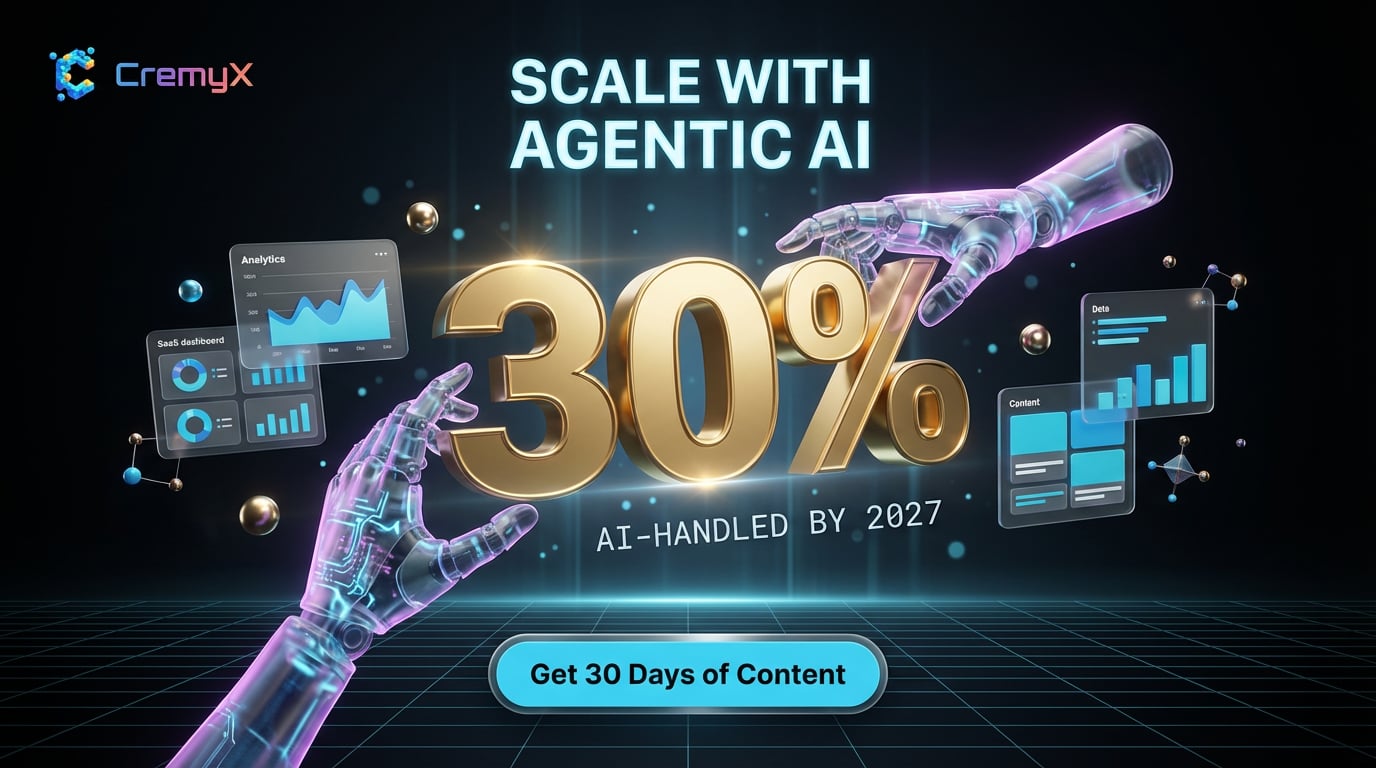
According to Gartner (2025), 30% of outbound marketing tasks will be handled by AI agents by 2027. Yet HubSpot (2025) reports that 76% of marketers feel they don't have enough time to execute their strategy — spending 62% of their time on operational tasks rather than strategic work.
This challenge isn't new, but it's intensifying. Marketing channels are proliferating, customer expectations for personalized experiences are soaring, and the demand for fresh, engaging content is relentless. Teams are stretched thin, often sacrificing strategic planning and creative innovation for the sheer volume of repetitive, often manual, execution. The promise of AI has been around, but many solutions offer only fragmented automation. What marketers truly need is a more sophisticated, autonomous, and intelligent assistant – an agent capable of understanding goals, planning actions, and executing multi-step tasks with minimal human intervention.
The Proven Approach: Implementing Agentic AI Workflows
The paradigm shift towards agentic AI offers a compelling solution to this operational bottleneck. Unlike simple automation tools that execute predefined scripts, agentic AI systems are designed to perceive their environment, reason about goals, plan actions, execute those actions, and learn from feedback. This allows them to handle complex, multi-stage marketing tasks autonomously, freeing human marketers to focus on high-level strategy, creative direction, and empathetic customer engagement.

Step 1: Identify High-Volume, Repeatable Tasks
According to McKinsey (2025), 45% of marketing activities can be automated with current AI technology. The first step to harnessing agentic AI is to pinpoint the tasks that consume significant human time but follow a predictable pattern. These are the low-hanging fruit for automation, where AI agents can quickly demonstrate value and build internal trust.
- Content repurposing across formats and platforms (e.g., turning a blog post into social media snippets, email newsletter sections, and video scripts).
- Social media scheduling and caption generation, tailored for different platforms and audience segments.
- Email personalization and A/B test creation, including subject lines, body copy variations, and call-to-action buttons.
- Report generation and performance tracking, synthesizing data from multiple sources into actionable insights.
- Competitive analysis, monitoring competitor activities, content, and ad strategies.
- Basic keyword research and content brief generation for SEO.
Focusing on these areas first allows for a controlled rollout, enabling teams to understand the capabilities and limitations of agentic AI before expanding its scope. The goal is not just to automate, but to elevate the quality and consistency of these tasks, often achieving results that surpass manual efforts due to AI's data-driven precision.
Step 2: Deploy AI Agents for Autonomous Execution
Forrester (2025) shows that marketing teams using AI agents for content production see 3x output with the same headcount. This isn't just about speed; it's about scalability and consistency. Once tasks are identified, the next step involves configuring and deploying AI agents to take ownership of these workflows.
- Set up AI agents with clear brand guidelines and quality parameters, ensuring all outputs align with the company's voice, tone, and visual identity. This includes providing examples of preferred content, style guides, and even negative examples to avoid.
- Create feedback loops where human reviewers train the AI on preferences and refine its understanding. This iterative process is crucial for the AI's continuous learning and improvement, making it more effective over time. Think of it as a junior team member learning the ropes.
- Start with low-risk tasks and gradually expand agent autonomy as confidence and performance metrics grow. For instance, begin with generating social media captions, then move to entire posts, and eventually to full campaign drafts.
- Integrate AI agents with existing marketing tools and platforms (e.g., CMS, social media schedulers, email platforms) to ensure seamless data flow and execution.
The key here is to treat AI agents not as mere tools, but as extensions of your team, capable of independent action within defined boundaries. Their autonomous nature allows them to execute tasks without constant supervision, responding to triggers and making minor adjustments based on learned patterns.
Step 3: Build Human-AI Collaboration Workflows
According to Deloitte (2025), the most effective AI implementations are "human-in-the-loop" — where AI handles execution and humans provide strategic direction. This symbiotic relationship is where the true power of agentic AI is unlocked. It's not about replacing humans, but augmenting their capabilities and enabling them to operate at a higher strategic level.
- Humans set strategy and brand guardrails; AI executes at scale, ensuring every piece of content or campaign adheres to the overarching vision. For example, a human strategist defines the quarterly marketing objectives, and AI agents then generate the necessary content and campaign elements to achieve those objectives.
- AI generates first drafts; humans review and refine, adding the unique creative flair, nuanced understanding, and emotional intelligence that only humans possess. This transforms the human role from content creator to content editor and enhancer.
- AI handles data analysis; humans interpret and make decisions, leveraging AI's ability to process vast datasets to identify trends, predict outcomes, and highlight opportunities that might otherwise be missed. The human element then translates these insights into actionable strategies.
- Humans oversee the AI's performance, providing ongoing feedback and adjusting parameters to optimize its output and ensure it aligns with evolving business goals and market dynamics. This continuous feedback loop ensures the AI agents remain effective and relevant.
This collaborative model ensures that while the grunt work is offloaded to AI, the strategic direction, ethical considerations, and creative oversight remain firmly in human hands. It fosters an environment where innovation thrives, as marketers have more time to experiment, analyze, and engage directly with their audience.
Deep Dive: The Architecture of Agentic AI in Marketing
Understanding what makes agentic AI distinct from traditional automation is crucial for effective implementation. While automation follows predefined rules, agentic AI operates with a degree of autonomy, capable of reasoning, planning, and adapting. This "agentic" quality allows it to tackle more complex, multi-step marketing challenges that would typically require significant human oversight.
At its core, an agentic AI system isn't a monolithic entity but a collection of interconnected modules working in concert. This architecture enables it to perceive its environment (e.g., marketing data, brand guidelines), process information, form a plan, execute actions, and learn from the outcomes.
Components of an Agentic AI System
- Large Language Model (LLM) Core: This is the brain, providing the natural language understanding and generation capabilities. It interprets human prompts, understands context, and generates human-like text for content creation, email personalization, or ad copy.
- Planning Module: This component breaks down complex marketing goals into a series of smaller, manageable tasks. For example, a goal like "launch a new product campaign" might be broken into "research target audience," "draft social media posts," "create email sequence," "schedule ads," and "monitor performance."
- Memory Module: Agentic AI systems possess both short-term (contextual) and long-term (knowledge base) memory. Short-term memory allows them to maintain coherence within a specific task, remembering previous interactions and generated content. Long-term memory stores brand guidelines, past campaign data, customer preferences, and successful strategies, ensuring consistency and continuous learning.
- Tool Use/Action Module: This module enables the AI agent to interact with external tools and APIs. For marketing, this means integrating with CRM systems, social media platforms, email marketing software, SEO tools, analytics dashboards, and content management systems. The agent can "use" these tools to perform actions like scheduling a post, sending an email, or pulling performance data.
- Feedback and Iteration Loop: Crucial for learning, this loop allows the agent to evaluate the outcome of its actions against the initial goal. If a social media post performs poorly, the agent can analyze the data, adjust its strategy (e.g., change the headline or image), and iterate on future posts. Human feedback is a vital part of this loop, guiding the AI's learning process.
Imagine tasking an agentic AI with "increase engagement on our latest blog post about sustainable packaging." The LLM understands the request. The planning module breaks it down: "generate social media posts for LinkedIn, Twitter, and Instagram, create a short email blast, and suggest relevant ad keywords." The memory module recalls brand voice and past successful engagement tactics. The tool use module then drafts content, schedules posts via a social media management tool, and integrates with the email platform. Finally, the feedback loop monitors engagement metrics, suggesting adjustments to future content. This multi-faceted approach is what sets agentic AI apart, enabling a more dynamic and intelligent scaling of marketing efforts. Learn more about AI marketing architecture.
Real-World Applications: Agentic AI Across Marketing Channels
The practical applications of agentic AI extend far beyond basic content generation. By leveraging its ability to plan, execute, and iterate, marketing teams can deploy agents across a multitude of channels, achieving unparalleled efficiency and personalization at scale. This comprehensive approach transforms how marketing departments operate, allowing them to cover more ground with greater precision.
Content Creation & SEO Optimization
Agentic AI can revolutionize the content pipeline, from ideation to optimization. Instead of just writing, agents can act as full-cycle content strategists and creators.
- Topic Ideation & Content Strategy: Agents analyze search trends, competitor content, and audience questions to propose high-potential blog topics, article outlines, and video scripts. They can even identify content gaps in your existing library.
- Draft Generation & Repurposing: Beyond initial drafts, agents can automatically adapt long-form content into various formats – short social media posts, email snippets, podcast summaries, or infographic text – ensuring message consistency across platforms.
- SEO Audit & Optimization: Agents can perform on-page SEO audits, suggesting keyword placements, meta description improvements, internal linking opportunities, and even generating schema markup to enhance search visibility.
- Competitive Content Analysis: Regularly monitor competitor content performance, identifying successful strategies and informing your own content calendar.
Social Media & Community Management
Managing a robust social media presence requires constant engagement and content. Agentic AI can streamline these efforts dramatically.
- Campaign Planning & Execution: Agents can plan entire social media campaigns, from setting objectives and identifying target audiences to generating diverse creative assets (images, videos) and scheduling posts across platforms.
- Post Scheduling & Optimization: Not just scheduling, but optimizing post times based on audience engagement data, and dynamically adjusting captions for different networks (e.g., more professional for LinkedIn, trendier for TikTok).
- Sentiment Analysis & Response Drafts: Monitor social media for brand mentions and sentiment, drafting initial responses to comments, questions, or complaints, which human moderators can then review and personalize.
- Ad Copy Generation & A/B Testing: Create multiple variations of ad copy, headlines, and calls-to-action for social media advertising, automatically A/B testing them to find the highest-performing combinations. Discover how AI agents boost social media ROI.
Email Marketing & Personalization
Email remains a powerhouse for direct marketing, and agentic AI elevates its effectiveness through hyper-personalization and automation.
- Audience Segmentation & Journey Mapping: Agents can analyze customer data to create highly granular audience segments and design personalized email journey maps, ensuring the right message reaches the right person at the right time.
- Email Sequence Generation: Automatically create entire email sequences – welcome series, nurturing campaigns, re-engagement flows – with dynamic content tailored to individual subscriber behavior and preferences.
- Subject Line & Body Copy Optimization: Generate multiple subject lines and email body variations, performing real-time A/B tests to maximize open rates and click-through rates.
- Triggered Email Automation: Configure agents to send automated, personalized emails based on specific customer actions (e.g., abandoned cart reminders, post-purchase follow-ups, birthday greetings).
Analytics & Reporting
Data is abundant in marketing, but insights are often scarce. Agentic AI can transform raw data into actionable intelligence.
- Automated Report Generation: Agents can pull data from various sources (Google Analytics, CRM, ad platforms) to generate comprehensive performance reports, highlighting key trends, anomalies, and areas for improvement.
- Predictive Analytics: Analyze historical data to forecast future trends, predict customer churn, or identify potential campaign risks and opportunities.
- Anomaly Detection: Proactively alert marketers to unusual spikes or drops in performance metrics, allowing for swift investigation and intervention.
- Personalized Dashboards: Create custom dashboards and summaries tailored to the specific needs of different team members or stakeholders, providing relevant data at a glance.
By implementing agentic AI across these diverse channels, marketing teams can achieve an unprecedented level of efficiency, personalization, and strategic impact, truly scaling their operations without proportionally scaling their headcount. This multi-modal application of AI agents is the future of lean, high-performing marketing departments.
Expected Results: Industry Benchmarks
The benefits of integrating agentic AI into marketing operations are not just theoretical; they are backed by compelling industry data demonstrating significant gains in efficiency, output, and strategic focus.
| Metric | Manual Process | With AI Agents | Source |
|---|---|---|---|
| Content output | Baseline | 3x with same team | Forrester, 2025 |
| Automatable tasks | 0% | 45% of activities | McKinsey, 2025 |
| Time on strategy | 38% | 60%+ | HubSpot, 2025 |
| Campaign launch speed | Weeks | Days | Gartner, 2024 |
| Personalization scale | Limited segments | Hyper-personalized 1:1 | Deloitte, 2025 |
| Marketing budget ROI | Standard | 15-20% uplift | Boston Consulting Group, 2024 |
These benchmarks illustrate a clear trajectory towards more agile, data-driven, and impactful marketing. The ability to increase content output threefold while freeing up valuable human time for strategic thinking represents a fundamental shift in marketing productivity. Furthermore, the acceleration of campaign launches and the unprecedented scale of personalization translate directly into stronger customer relationships and improved return on marketing investment.
Overcoming Implementation Hurdles & Best Practices for Adoption
While the benefits of agentic AI are clear, successful implementation requires careful planning and strategic execution. Organizations often face challenges related to data quality, integration complexities, and change management. Addressing these proactively ensures a smooth transition and maximizes the ROI of AI investments.
Strategic Phased Rollout
Attempting to automate everything at once can lead to overwhelming complexity and resistance. A phased approach is critical.
- Start with Pilot Projects: Identify a high-impact, low-risk area (e.g., social media caption generation or initial content drafts) for a pilot program. This allows your team to gain familiarity with the AI agents and demonstrate early wins.
- Identify Internal Champions: Designate specific team members to become "AI evangelists" who champion the new workflows, provide feedback, and help onboard their colleagues. Their success stories will be crucial for broader adoption.
- Iterative Learning & Optimization: Treat AI implementation as an ongoing process. Continuously gather feedback from users, monitor AI agent performance, and make iterative adjustments to prompts, guidelines, and integrations. This ensures the AI systems evolve with your team's needs and market changes.
Data Governance and Security
Agentic AI thrives on data. The quality, accessibility, and security of your marketing data are paramount.
- Data Cleanliness: Ensure your existing marketing data (CRM, analytics, past content) is clean, structured, and consistent. "Garbage in, garbage out" applies strongly to AI. Invest in data cleansing and standardization efforts before extensive AI deployment.
- Integration Strategy: Plan how your AI agents will integrate with your existing marketing technology stack. Prioritize secure, API-driven integrations to ensure seamless data flow without compromising data integrity or privacy.
- Security and Compliance: Implement robust data security protocols and ensure compliance with relevant data privacy regulations (e.g., GDPR, CCPA). AI agents should operate within strict ethical guidelines, especially when handling customer data. Establish clear policies on data usage and retention.
Training and Upskilling Your Team
The shift to agentic AI workflows is a transformation, not just a tool adoption. Investing in your human capital is non-negotiable.
- Focus on AI Literacy: Provide training for your marketing team on how to interact with AI agents, how to craft effective prompts, and how to critically evaluate AI-generated content. The role shifts from execution to strategic oversight and refinement.
- Emphasize Strategic Thinking: Encourage team members to leverage the time saved by AI to focus on higher-value activities: deeper customer insights, innovative campaign concepts, brand storytelling, and direct customer engagement.
- Foster a Culture of Experimentation: Encourage your team to experiment with AI agents, explore new use cases, and share their learnings. A culture that embraces innovation will unlock the full potential of agentic AI.
By proactively addressing these challenges and adopting a strategic approach to implementation, organizations can successfully integrate agentic AI into their marketing operations, transforming them into more agile, efficient, and innovative engines of growth. Explore AI implementation best practices.
The Future Landscape: Agentic AI as a Strategic Imperative
The evolution of agentic AI is not just another technological trend; it's rapidly becoming a strategic imperative for marketing leaders. As competition intensifies and customer expectations continue to rise, the ability to operate at scale with unprecedented personalization will define market leaders. Agentic AI offers a pathway to this future, transforming marketing departments from cost centers into powerful growth engines.
The future of marketing will be characterized by a seamless blend of human creativity and AI efficiency. Marketers will spend less time on manual tasks and more time on high-level strategy, empathetic customer engagement, and innovative campaign design. AI agents will act as intelligent co-pilots, handling the heavy lifting of execution, data analysis, and optimization, allowing humans to focus on the unique aspects of brand building and emotional connection that only they can provide.
Emerging Trends
- Multimodal Agents: Future agents will not be limited to text generation. They will seamlessly create and manage content across text, images, video, and audio, orchestrating complex multimedia campaigns autonomously.
- Hyper-Personalization at Scale: Agentic AI will enable true 1:1 personalization across the entire customer journey, dynamically adapting messages, offers, and experiences in real-time based on individual behavior and context.
- Predictive and Proactive Marketing: Agents will move beyond reactive execution to proactive prediction. They will anticipate market shifts, identify emerging trends, and even predict customer needs before they arise, automatically initiating marketing actions.
- Autonomous Campaign Management: The vision is for agents to manage entire campaigns from inception to optimization, including budget allocation, A/B testing, and real-time adjustments, with human oversight at key decision points.
Embracing agentic AI is no longer optional for businesses aiming for sustained growth and market leadership. It's an investment in future agility, efficiency, and competitive advantage. Those who adopt these intelligent workflows early and strategically will be best positioned to navigate the complexities of the modern marketing landscape.
How to Get Started with CremyX
CremyX acts as your AI marketing agent — generating on-brand content, designs, and marketing plans based on your brand identity. Import your brand once, and CremyX becomes your always-on marketing team member. It's designed to implement the very agentic workflows discussed in this guide, allowing you to scale your operations without the complexity of building bespoke AI systems.
With CremyX, you can define your marketing goals, provide your brand assets, and let our intelligent agents get to work. From crafting compelling social media posts to generating personalized email campaigns and optimizing your content for SEO, CremyX empowers your team to focus on strategy while the AI handles the execution, consistently, and on-brand. It streamlines the human-in-the-loop process, making it intuitive to review, refine, and approve AI-generated outputs, ensuring your brand voice is always spot-on.
Ready to scale your marketing? Start with CremyX and let AI handle execution while you focus on strategy.
📈 Apply These Strategies with CremyX
CremyX helps you implement the same strategies shown in this case study. Import your brand, get AI-powered content, and start your 30-day marketing plan today.
Explore more: Best AI Marketing Tools 2026 · Complete AI Marketing Strategy FAQ
Key Takeaways
- Marketing agencies using agentic AI workflows scale operations 3x faster with the same team size (Gartner 2024).
- Agentic AI differs from simple automation: agents can plan, execute, and iterate on multi-step marketing tasks autonomously, acting more like intelligent team members.
- Start with high-volume, repetitive workflows: social media scheduling, report generation, competitive analysis, and initial content drafts are excellent starting points.
- Human oversight remains essential — use "human-in-the-loop" for strategy decisions, creative refinement, and ethical considerations, letting AI handle the execution at scale.
- ROI timeline: expect 30-40% efficiency gains within the first quarter, compounding as agents learn your preferences and integrate more deeply into your workflows.
- Successful implementation requires a phased rollout, robust data governance, and upskilling your team to effectively collaborate with AI agents.
- Agentic AI is not just about automation; it's about transforming marketing into a more strategic, personalized, and efficient function, becoming a competitive necessity.
Explore the comparison in single-channel vs multimodal marketing and understand agentic AI in marketing.