Multi-Agent AI Systems: How Autonomous AI Teams Run Your Marketing
What Are Multi-Agent AI Systems in Marketing?
Beyond Single AI: The Team Approach
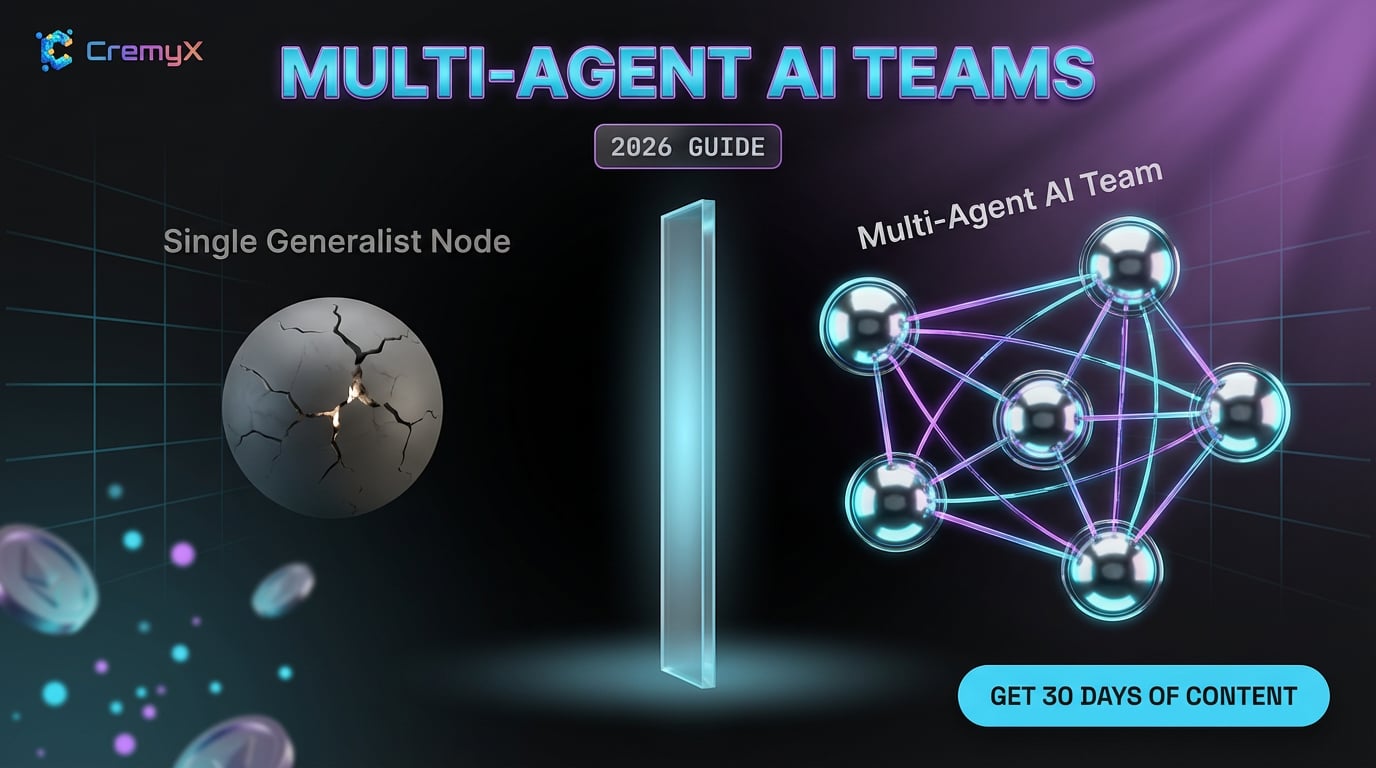
Traditional AI marketing tools operate as a single system — one AI that tries to do everything. Multi-agent AI systems take a fundamentally different approach: they deploy multiple specialized AI agents, each with distinct capabilities, that collaborate to achieve marketing objectives. Think of it as the difference between hiring one generalist employee versus building a specialized team.

Each agent in a multi-agent marketing system has a specific role, domain expertise, and set of tools. A content agent understands copywriting, brand voice, and content strategy. An analytics agent specializes in data interpretation, trend detection, and performance measurement. A strategy agent orchestrates the entire team, making high-level decisions about resource allocation and campaign direction.
How Multi-Agent Orchestration Works
The orchestration layer is the backbone of any multi-agent system. It manages communication between agents, resolves conflicts, prioritizes tasks, and ensures all agents work toward the same business objectives. Here's a typical flow:
- Strategy Agent receives business goals (e.g., "increase Q3 leads by 30%") and translates them into actionable marketing objectives. This agent acts as the team leader, setting the overall direction and breaking down complex goals into manageable sub-tasks for other agents.
- It decomposes the goal into sub-tasks and assigns them to specialized agents, ensuring efficient allocation of resources and expertise. This involves understanding each agent's capabilities and matching tasks to the most suitable AI.
- Analytics Agent analyzes current performance and identifies opportunities, providing data-driven insights to inform strategic decisions. This agent continuously monitors key metrics and reports on trends, allowing for proactive adjustments to campaigns.
- Content Agent creates targeted content for identified opportunities, adhering to brand guidelines and optimizing for audience engagement. This includes generating text, images, and video, ensuring relevance and quality across all outputs.
- Distribution Agent schedules and publishes across channels, optimizing timing and platform selection for maximum reach and impact. This agent manages social media, email, paid ads, and other channels, ensuring content is delivered effectively.
- Engagement Agent monitors responses and handles interactions, fostering community and addressing customer inquiries in real-time. This agent provides personalized responses and escalates complex issues to human team members when necessary, maintaining positive customer relationships.
- Results flow back to the Strategy Agent, which adjusts the plan accordingly, creating a continuous feedback loop for ongoing optimization. This iterative process allows the system to adapt to changing market conditions and improve performance over time.
Single-Agent vs Multi-Agent: Key Differences
| Aspect | Single-Agent AI | Multi-Agent AI |
|---|---|---|
| Specialization | Jack of all trades, often sacrificing depth for breadth in capabilities. This can lead to generic outputs or a lack of nuanced understanding in complex marketing tasks. | Deep domain expertise per agent, allowing for highly specialized and high-quality outputs in specific areas. Each agent focuses on mastering a particular function, leading to superior performance. |
| Scalability | Limited by single model capacity, making it challenging to handle increasing workloads or diverse tasks simultaneously. Adding more features often degrades overall performance. | Scales by adding more agents or duplicating existing ones, distributing workload and maintaining performance. This modular approach allows for flexible growth and adaptation to changing demands. |
| Fault Tolerance | Single point of failure; if the core AI system encounters an error, the entire marketing operation can halt. This poses a significant risk for continuous campaign execution. | Other agents compensate for failures, ensuring continuous operation even if one agent experiences issues. The system can re-route tasks or leverage redundancy to maintain workflow integrity. |
| Complexity Handling | Struggles with multi-step tasks requiring diverse skill sets and sequential decision-making. Its generalized nature limits its ability to execute intricate marketing strategies effectively. | Excels at complex workflows by breaking them down into manageable tasks for specialized agents. This collaborative approach allows for sophisticated campaign execution and problem-solving. |
| Cost | Lower initial cost due to simpler architecture and fewer components. However, this often comes at the expense of performance and long-term scalability. | Higher but better ROI at scale, as the specialized nature and collaborative efficiency lead to superior results and adaptability. The initial investment is justified by enhanced performance and strategic advantage. |
The Five Core Marketing Agents
1. The Strategy Agent (The Orchestrator)
The strategy agent sits at the top of the hierarchy. It understands business objectives, market conditions, and competitive landscape. Its responsibilities include:

- Decomposing high-level goals into actionable marketing tasks, ensuring every action aligns with overarching business objectives. For example, turning a "30% lead increase" into specific content, analytics, and distribution goals.
- Allocating resources (budget, content volume, channel focus) across agents to maximize efficiency and impact. This agent dynamically adjusts resource distribution based on real-time performance data and strategic priorities.
- Monitoring overall campaign performance and adjusting strategy in real-time to optimize outcomes. It acts as the central intelligence, making high-level decisions based on aggregated data from all other agents.
- Resolving conflicts between agent recommendations (e.g., when the content agent wants more blog posts but the analytics agent suggests video performs better) by weighing different data points and strategic priorities. This ensures cohesive decision-making and prevents contradictory actions within the system.
2. The Content Agent (The Creator)
Specialized in content creation across all formats — blog posts, social media captions, email copy, ad creative, video scripts. The content agent maintains a deep understanding of brand voice, audience preferences, and platform-specific best practices. It doesn't just write — it plans content calendars, identifies content gaps through keyword analysis, and ensures topical authority.
3. The Analytics Agent (The Analyst)
This agent continuously monitors performance data across all channels. It identifies trends, detects anomalies, and provides actionable insights. Key capabilities include:

- Real-time campaign performance monitoring, providing immediate feedback on active marketing initiatives. This allows for rapid adjustments to optimize spend and messaging.
- Audience behavior analysis and segmentation to understand customer journeys and tailor marketing efforts. By identifying distinct audience groups, the agent helps personalize content and offers.
- Competitor activity tracking, offering insights into market positioning and potential opportunities or threats. This includes monitoring competitor campaigns, keywords, and audience engagement.
- Predictive analytics for future performance, forecasting trends and potential outcomes based on historical data. This helps the strategy agent make informed decisions about future campaigns.
- Attribution modeling across touchpoints, determining which marketing efforts contribute most to conversions and revenue. This provides a clear understanding of ROI for different channels and campaigns.
4. The Distribution Agent (The Publisher)
Handles the logistics of getting content to the right audience at the right time. This includes optimal scheduling, cross-platform publishing, A/B test setup, audience targeting configuration, and paid media budget management. The distribution agent learns from past performance to optimize timing and channel selection.
5. The Engagement Agent (The Communicator)
Manages real-time interactions with the audience — responding to comments, handling customer inquiries, moderating discussions, and identifying opportunities for proactive engagement. It maintains conversation context and can escalate complex issues to human team members when needed.
Real-World Multi-Agent Marketing Architectures
Architecture 1: Hub-and-Spoke Model
The most common architecture places the strategy agent at the center (hub) with specialized agents radiating outward (spokes). All communication flows through the strategy agent, which maintains a global view of marketing operations. This model is ideal for organizations that want tight strategic control.
Architecture 2: Peer-to-Peer Collaboration
In this model, agents communicate directly with each other. The content agent can request data directly from the analytics agent without going through the strategy agent. This creates faster feedback loops but requires more sophisticated conflict resolution mechanisms. Best for high-velocity marketing environments.
Architecture 3: Hierarchical Teams
Large organizations may deploy multiple agent teams, each responsible for a product line, geographic region, or customer segment. A meta-strategy agent coordinates across teams. This architecture scales well for enterprise organizations managing multiple brands or markets simultaneously.
CremyX's Multi-Agent Approach
CremyX implements a practical multi-agent architecture that's accessible to businesses of all sizes. When you onboard your brand, multiple specialized agents work together:
- A Brand Analysis Agent deeply studies your website, visual identity, and market positioning to build a comprehensive brand profile. This agent ensures all generated content aligns perfectly with your established brand guidelines and tone of voice.
- A Content Strategy Agent plans your 30-day content calendar based on industry trends and competitor analysis, identifying optimal topics and formats. This agent leverages SEO data and audience insights to maximize content relevance and potential reach.
- A Creative Agent generates platform-specific content, images, and AI UGC videos, adapting outputs for maximum engagement on each channel. This agent ensures visual and textual elements are optimized for platforms like Instagram, TikTok, or LinkedIn.
- A Quality Agent ensures every output aligns with your brand guidelines, checks for factual accuracy, and polishes content for grammar and readability. This agent acts as a final gatekeeper, guaranteeing high-quality, on-brand deliverables before publication.
This multi-agent coordination is why CremyX can maintain brand consistency across dozens of content pieces — each agent specializes in what it does best.
Implementing Multi-Agent Marketing
Step 1: Map Your Marketing Workflow
Before deploying agents, document your current marketing workflow end-to-end. Identify every step from strategy to execution to analysis. Look for:
- Repetitive tasks that could be handled by specialized agents, such as generating social media captions or basic email drafts. Automating these frees up human marketers for more strategic work.
- Decision points where data-driven automation would improve outcomes, like optimizing ad spend based on real-time performance. Multi-agent systems can make these decisions faster and more accurately than humans.
- Bottlenecks where work queues up waiting for specific team members, indicating areas where an agent could streamline processes. For example, a content agent could quickly produce drafts that a human then refines.
- Handoff points between team members (these become inter-agent communication channels), which need clear protocols for data transfer and task delegation. Defining these ensures smooth transitions within the automated workflow.
Step 2: Define Agent Responsibilities
Based on your workflow map, define clear boundaries for each agent. Avoid overlapping responsibilities, which create conflicts. Each agent should have:
- A specific domain of expertise, such as SEO content generation or social media analytics, to ensure focused and high-quality output. This prevents agents from attempting tasks outside their core competency.
- Clear input/output specifications, detailing what information an agent needs to perform its task and what format its results should take. This standardization facilitates seamless communication between agents.
- Defined decision-making authority, outlining the scope within which an agent can act autonomously without human intervention. This could range from scheduling a social post to adjusting a minor ad bid.
- Escalation rules for edge cases, specifying when an agent should flag an issue or seek human oversight. This ensures critical or unusual situations are handled by human intelligence.
Step 3: Build the Orchestration Layer
The orchestration layer is critical. It must handle:
- Task routing: Directing work to the appropriate agent based on predefined rules and dynamic conditions. This ensures that content creation tasks go to the content agent, while performance monitoring goes to the analytics agent.
- Conflict resolution: When agents disagree on a course of action, the orchestrator decides based on overarching strategic goals or pre-set priorities. This prevents internal friction and maintains system coherence.
- Priority management: Ensuring urgent tasks get processed first, dynamically reordering workflows as business needs change. For instance, a critical product launch campaign might take precedence over routine content updates.
- Quality control: Validating agent outputs before external actions, often through a combination of automated checks and human review. This final check ensures brand consistency and accuracy before content goes live.
Step 4: Implement Feedback Loops
Multi-agent systems improve through feedback. Implement loops where:
- The analytics agent's performance data improves the content agent's output by providing insights into what resonates with the audience. For example, if video content performs better, the content agent will prioritize video creation.
- The engagement agent's audience insights refine the strategy agent's plans, allowing for more targeted and effective campaign adjustments. Direct feedback from customer interactions can inform future marketing directions.
- Human oversight provides corrections that improve all agents simultaneously, acting as a critical learning input for the entire system. Regular human review helps fine-tune agent behavior and ensures alignment with evolving brand values.
Measuring Multi-Agent Marketing Performance
System-Level Metrics
- Campaign velocity: Time from strategy to live campaign (target: 75% reduction), indicating the speed and efficiency of the entire multi-agent system. This metric highlights how quickly new initiatives can be deployed.
- Cross-channel consistency: Brand alignment score across all channels, measuring how well the multi-agent system maintains a unified brand voice and visual identity. Tools can analyze tone, messaging, and visual elements for cohesion.
- Overall marketing ROI: Revenue per marketing dollar with multi-agent system, providing a holistic view of the financial impact and efficiency. This is the ultimate measure of the system's business value.
- Human time saved: Hours freed for strategic work per week, quantifying the operational efficiency gains by automating repetitive tasks. This metric demonstrates the value of reallocating human talent to higher-level activities.
Agent-Level Metrics
- Content Agent: Output volume, engagement rates, brand voice consistency score, and conversion rates of content produced. This measures the quantity, quality, and effectiveness of generated content.
- Analytics Agent: Insight accuracy, prediction precision, anomaly detection speed, and the percentage of actionable insights generated. This assesses the agent's ability to provide timely and relevant data-driven recommendations.
- Distribution Agent: Optimal timing accuracy, reach efficiency, cost per impression, and click-through rates across various channels. This evaluates how effectively content is delivered to the target audience.
- Strategy Agent: Goal achievement rate, resource allocation efficiency, and the speed of strategic adjustments based on new data. This measures the agent's effectiveness in guiding the overall marketing effort.
Optimization Strategies
Multi-agent systems should be continuously optimized. Key strategies:
- A/B test different agent configurations and collaboration patterns to identify the most effective setups for specific marketing goals. This iterative testing helps refine the system's architecture and inter-agent communication.
- Gradually increase agent autonomy as confidence in their decisions grows, allowing them to handle more complex tasks without human intervention. This process involves careful monitoring and validation of agent performance.
- Add specialized agents for emerging channels (TikTok, Threads, etc.) or niche marketing functions as needs arise. This ensures the system remains agile and can adapt to new platforms and trends.
- Implement cross-agent learning where insights from one agent improve others, fostering a collaborative and continuously evolving intelligence. For example, engagement agent feedback can directly inform content agent strategies.
Challenges and Solutions
Agent Coordination Complexity
The more agents you deploy, the more complex coordination becomes. Solution: start with 2-3 core agents and expand gradually. Use well-defined communication protocols and keep the orchestration layer simple initially.
Data Consistency Across Agents
Multiple agents accessing the same data can create consistency issues. Solution: implement a shared data layer that all agents read from and write to, with proper versioning and conflict resolution. This ensures a single source of truth for all marketing data.
Cost Management
Running multiple AI agents simultaneously costs more than a single system. Solution: measure ROI per agent and decommission agents that don't justify their cost. Most businesses find that the increased efficiency far outweighs the additional AI compute costs.
The Future of Multi-Agent Marketing
What's Coming in 2027 and Beyond
Multi-agent marketing is evolving rapidly. Emerging trends include:
- Cross-company agent collaboration: Your marketing agents communicating directly with partner company agents for co-marketing campaigns, automating complex joint ventures. This could streamline content syndication, shared promotions, and joint analytics.
- Self-improving agent teams: Systems that automatically add, remove, or reconfigure agents based on performance and evolving business needs. These systems will learn from their own successes and failures to optimize their structure.
- Specialized vertical agents: Industry-specific agents for healthcare, real estate, SaaS, and other sectors, pre-trained on domain-specific knowledge and compliance requirements. These agents will offer highly tailored and accurate marketing solutions.
- Agent marketplaces: Platforms where you can deploy pre-trained agents for specific marketing functions, allowing businesses to easily customize and scale their AI marketing teams. This will democratize access to advanced multi-agent capabilities.
The businesses that invest in multi-agent marketing infrastructure today will have a significant competitive advantage as these systems mature. Agentic AI is not a trend — it's the foundation of how marketing will operate in the coming decade.
Frequently Asked Questions
How many agents do I need to start?
Start with 2-3 core agents: a content agent, an analytics agent, and a strategy/orchestration agent. This covers the most critical marketing functions. Add specialized agents (distribution, engagement) as you scale and identify specific needs.
Can small businesses use multi-agent marketing?
Yes. Platforms like CremyX package multi-agent capabilities into accessible tools that SMBs can use without technical expertise. You don't need to build agents from scratch — you leverage pre-built agent systems designed for marketing workflows.
What's the difference between multi-agent AI and marketing automation?
Marketing automation follows fixed rules (if subscriber opens email, send follow-up after 3 days). Multi-agent AI systems reason about the best course of action dynamically. They can decide to change the follow-up timing, content, and channel based on real-time context — a fundamentally different level of intelligence.
💡 Put These Tips Into Action with CremyX
Stop reading tips and start implementing them. CremyX analyzes your brand and generates ready-to-publish content that follows these best practices automatically.
Learn more: AI Marketing for Small Business · Best AI Tools FAQ